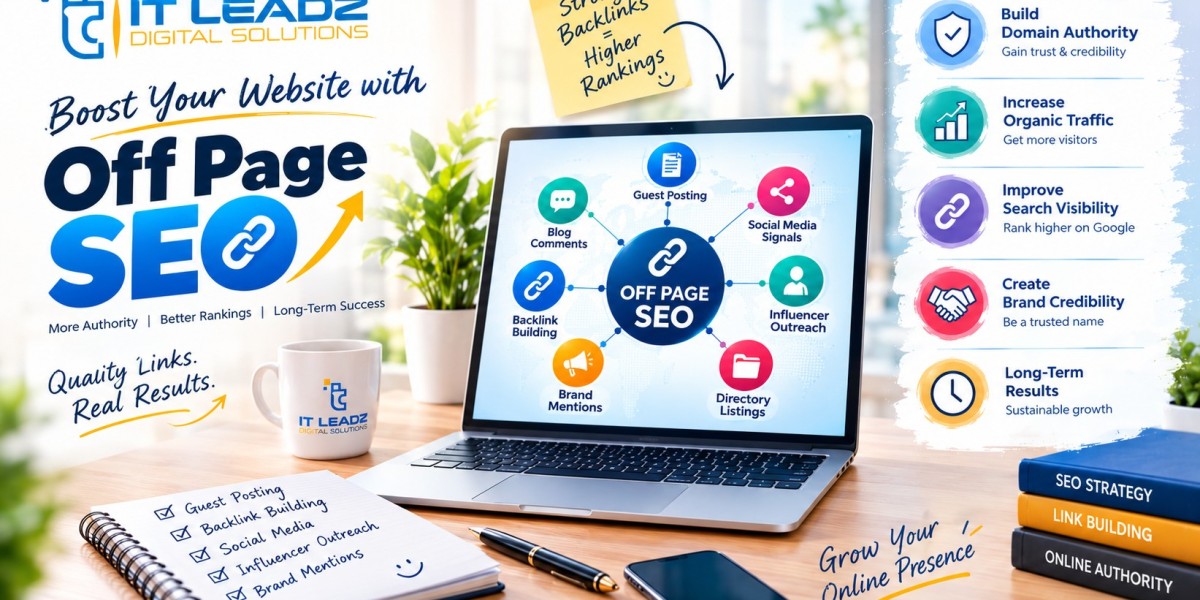

Every website owner eventually hits the same wall. The pages are well written, the titles are tidy, the site loads quickly yet competitors with weaker content keep outranking you. Very often the missing piece sits outside your own domain. Search engines do not judge a website only by what it says about itself. They also weigh what the rest of the web says about it. That outside evidence is the heart of Off Page SEO.
This Off Page SEO guide explains the whole picture in plain language. You will learn what it is, why it matters, which Off Page SEO ranking factors carry the most weight which methods and activities are worth your time. It is written for Off Page SEO for beginners as well as for marketers who want a cleaner framework. We also cover how offsite signals now influence answer engines, AI summaries and large language models, because visibility today is no longer limited to ten blue links.
What Is Off Page SEO?
Off Page SEO covers every action that happens away from your website and improves how search engines and people perceive it. Onpage SEO controls what you publish and how it is structured. Technical SEO controls how well your site can be crawled and rendered. Offpage work builds the reputation that tells search engines your site deserves to be shown. The most familiar part is link building, which means earning links from other websites. But the discipline is wider than links. It includes brand mentions, digital PR, reviews, social discussion, podcast appearances, expert quotes, directory listings, partnerships and community participation.
All of these send signals about who you are, how trusted you are and whether real people value what you offer. A helpful way to think about it is word of mouth at scale. A restaurant with great food but no reviews and no recommendations struggles to attract new diners. A restaurant that people talk about, link to and recommend fills its tables. Search engines try to mimic that human judgement Off Page SEO is how you earn it.
The Benefits of Off Page SEO
The Off Page SEO benefits go well beyond a bump in positions. When the work is done properly, it compounds over time and supports almost every other marketing channel.
First, it raises authority. Each trustworthy mention makes your domain look more credible to search engines. Second, it improves rankings for competitive terms where onpage work alone is not enough. Third, it drives referral traffic from the sites that link to you those visitors tend to arrive with genuine interest. Fourth, it speeds up indexing, because crawlers discover new pages faster when external sites point to them. There is also a brand benefit that is easy to overlook. When people repeatedly see your name in articles, interviews and community discussions, they start to trust you before they ever visit your site.
That familiarity lifts clickthrough rates and conversions. Finally, a strong offsite footprint protects you. Sites with diverse, natural signals are more resilient during algorithm updates than sites that rely on a handful of thin tactics. Google’s original ranking system, PageRank, was built on the idea that links act as votes of confidence. Decades later, links remain one of the signals search engines use to understand the importance of a page.
How Search Engines Interpret OffSite Signals
Search engines cannot visit your business, taste your product or read your customer reviews in the way a person would. They rely on proxies. When a respected publication links to your guide, that is a proxy for expertise. When customers consistently praise you across review platforms, that is a proxy for trust. When your brand name appears in discussions about a topic, that is a proxy for relevance. Modern systems also look at context. A link surrounded by relevant text, placed on a page that covers a similar topic, carries more meaning than a link dropped into an unrelated footer.
The words used in the anchor and the surrounding paragraph help search engines understand what the linked page is about. Equally important is pattern recognition. Natural link profiles grow gradually, come from varied sources and use varied wording. Unnatural profiles show sudden spikes, repeated exact match anchors and links from irrelevant or low quality sites. Search engines have become very good at spotting those patterns, which is why shortcuts rarely last.
Off Page SEO Ranking Factors at a Glance
Not every offsite signal is equal. The table below summarises the Off Page SEO factors that matter most and what each one tells search engines.
OffPage Factor | What It Signals | How to Strengthen It |
Referring domains | Breadth of endorsement from different sites | Earn links from varied, relevant publishers |
Link quality and relevance | Trust and topical fit | Target sites in your industry with real audiences |
Anchor text variety | Natural link patterns | Encourage descriptive, branded and varied anchors |
Brand mentions | Recognition and reputation | Digital PR, expert commentary, partnerships |
Reviews and ratings | Customer satisfaction | Request reviews and respond to every one |
Social and community engagement | Audience interest | Share useful content and join real discussions |
Content shares and citations | Value of your original research | Publish data, tools and original insights |
Local citations | Business legitimacy | Keep name, address and phone details consistent |
Use this as a working map. If your profile is strong in one row and empty in another, that gap is usually where the next gain sits.
Backlinks Why Quality Beats Quantity
Off Page SEO backlinks remain the most discussed signal for good reason. A backlink is a visible, countable endorsement. But a backlink from a respected, relevant publication can be worth more than hundreds of links from weak directories.Quality has several parts. The linking site should be trustworthy and genuinely used by real readers. The page should be relevant to your topic. The link should sit within editorial content rather than a sponsored block. And the link should send a clear, natural signal through its anchor text. Link attributes also matter.
Since 2019, Google has recognised rel="sponsored" and rel="ugc" alongside no follow treats these as hints rather than strict commands. A mixed profile that includes some no follow links looks perfectly natural, so do not avoid them. A large Backlinko study of 11.8 million Google results found that the page in first position had, on average, around 3.8 times more backlinks than pages in positions two to ten. Correlation is not causation, but the pattern shows how closely authority and visibility travel together.
Off Page SEO Link Building Methods That Hold Up
Effective Off Page SEO link building starts with something worth linking to. Original research, free tools, templates, definitive guides and expert commentary all attract links without begging for them. Once you have a strong asset, there are several reliable ways to get it noticed. Digital PR places your data or expert opinion in news and industry publications. Guest contributions on respected sites build both links and credibility, provided the content genuinely helps their readers.
Broken link replacement finds dead pages that others link to and offers your resource as a substitute. Resource page outreach gets you included on curated lists that readers actually use. Unlinked mention reclamation turns existing brand mentions into links with a short, friendly message. Partnerships and testimonials also work. If a supplier or software provider uses your feedback on their website, it often comes with a link. Sponsoring a local event or a niche community can do the same. What does not hold up is buying bulk links, joining link exchanges or using private blog networks. These tactics break search engine guidelines and put your site at risk.
Brand Mentions and Digital PR
Links are not the only way to be recognised. Search engines and AI systems increasingly understand brand mentions, even when no clickable link is present. When your company name appears alongside a topic in credible content, it strengthens the association between the two. Digital PR is the most dependable way to earn those mentions. It means creating stories that journalists and editors actually want to cover, such as survey results, trend analysis, expert predictions or behind the scenes insight.
Responding quickly to journalist requests with a concise, quotable answer is another proven route. Consistency helps. Use the same brand name, the same spokesperson details and the same short company description everywhere. That makes it easy for search engines to connect scattered mentions into a single, confident entity.
Social Signals, Reviews and Community Activities
Social shares are not a direct ranking factor in the way links are, but social and community activities still support the same goals. They put your content in front of people who might link to it, they build brand recall and they create the kind of discussion that search engines notice. Reviews deserve particular attention. They influence click behaviour, build trust and, for local searches, can strongly shape visibility.
Ask satisfied customers for honest feedback, make the process easy and always reply, including to critical comments. A calm, helpful response shows prospects how you treat people. Communities matter too. Answering questions in forums, industry groups and Q and A platforms positions you as a helpful expert. Avoid dropping links for their own sake. Contribute real value first let your profile and occasional relevant resources do the rest.
Off Page SEO Optimization for Answer Engines (AEO)
Answer engines aim to give users a direct response rather than a list of pages. Voice assistants, featured snippets and conversational search tools all fall into this group. To be chosen as the source of an answer, your content must be clear and your brand must be trusted. That trust is built offsite.
When reputable sources cite you, when your name appears in expert roundups and when your answers are echoed across credible pages, answer engines have more reason to rely on you. This is why specialist Off Page SEO Optimization that supports AEO Services combines structured on page answers with strong external validation. In practice, that means creating concise, quotable explanations, earning citations from authoritative sources and keeping your business details consistent across the web.
Off Page SEO for Organic Traffic in the Age of AI Overviews
AI generated summaries now appear at the top of many search results they pull from sources the system considers dependable. Being cited there can bring qualified visitors, even when fewer people click through the traditional listings. Building Off Page SEO for Organic Traffic that survives this shift means thinking beyond a single ranking position. You want your brand present in the sources that these summaries draw from industry publications, respected directories, community discussions and welllinked guides.
A focused AIO Services approach pairs that external presence with content that answers questions completely and honestly. Google began rolling out AI Overviews widely in the United States in May 2024 and has expanded them since, which has made source credibility more important than ever.
Off Page SEO for Website Authority and Generative Engines (GEO)
Generative engines assemble answers from many sources and often name the brands they trust. To be included, your website needs a clear identity and a broad, consistent footprint. Off Page SEO for Website Authority supports exactly that, because every credible mention, review and link adds to how confidently a system can describe you. Consistency is vital here. If your company is described differently across directories, profiles and articles, generative systems may struggle to connect the dots. Keep your naming, services and key facts aligned.
Then build a steady stream of independent mentions from relevant, trusted publications. A dedicated GEO Services strategy turns those signals into measurable visibility in AIdriven results. An Ahrefs analysis of AI Overview visibility found that brand mentions across the web correlated more strongly with appearing in those summaries than backlinks did, which shows how far reputation now reaches beyond links alone.
Off Page SEO Methods for Large Language Models (LLMO)
Large language models learn from vast amounts of public text and, in many tools, retrieve live information to support their answers. The brands they mention tend to be those that appear repeatedly, accurately and in credible contexts. Off Page SEO Methods that support this include publishing original, citable data, earning coverage in respected publications, maintaining accurate profiles on trusted platforms and contributing expert commentary that can be quoted. Clear, factual language is easier for models to reproduce correctly than vague marketing copy. This emerging area is often called LLMO Services . It does not replace classic SEO. It extends it, using the same foundation of authority, accuracy and visibility across the web.
Off Page SEO for Beginners A Simple 90Day Plan
If you are new to this, start small and stay consistent. In the first month, audit what you already have. List your existing links, mentions, reviews and profiles fix any inconsistent business details. Claim the profiles that matter for your industry.In the second month, create one asset worth sharing, such as a dataled guide, a free template or an expert roundup. Identify a short list of relevant publications, creators and communities begin personalised outreach. Aim for quality of conversation, not volume of emails.
In the third month, review results. Which outreach earned replies? Which content attracted links or mentions? Double down on what worked and refine the rest. Keep requesting reviews, keep contributing in communities and keep tracking progress in a simple spreadsheet.Patience matters. Authority builds gradually the sites that win are usually the ones that keep going after the first quiet month.
Common Mistakes to Avoid
Several errors appear again and again. Chasing sheer volume leads to weak, irrelevant links that add little and can cause harm. Overoptimised anchor text, where most links use the same exact phrase, looks unnatural. Ignoring relevance, by pursuing any link regardless of topic, wastes effort. Neglecting existing mentions leaves easy wins unclaimed. Another common mistake is treating Off Page SEO as a one off campaign.
Reputation is continuous. Competitors keep earning links audiences keep forming opinions. A steady, modest effort beats an occasional burst.Finally, do not neglect your own site. Outreach works best when the destination page is useful, fast and clear. Strong on page foundations make every external signal more effective.
How to Measure Off Page SEO Success
Track a balanced set of indicators. Watch referring domains and the quality of new links, not just the total count. Monitor branded search volume, which often rises as awareness grows. Review referral traffic and, more importantly, whether those visitors engage or convert. Follow ranking movement for your priority terms note the growth of reviews and ratings. Also keep an eye on AI visibility. Check whether your brand is named or cited in generative answers for your key topics note which sources those answers rely on. That tells you where to focus your next round of outreach. Report monthly, compare against a baseline and look for trends rather than daily noise.
Final Thoughts
Off Page SEO is the long game of earning trust. It rewards businesses that publish genuinely useful work, build real relationships and stay consistent. With search now spanning classic results, answer engines, AI summaries and language models, the external signals you earn matter more than ever. If you would like expert support turning these ideas into results, explore our Off Page SEO Services and see how a structured, whitehat approach can strengthen your authority across every kind of search.
Frequently Asked Questions(FAQs)
What is Off Page SEO in simple terms?
It is everything you do outside your own website to build authority, trust and visibility, including earning backlinks, brand mentions, reviews and community engagement.
How long does Off Page SEO take to show results?
Most sites begin to see early movement within three to six months, though competitive markets can take longer. Authority builds gradually and compounds over time.
Are backlinks still important?
Yes, Backlinks remain a core signal of trust and relevance, but they now work alongside brand mentions, reviews and other offsite evidence.
Is Off Page SEO different from link building?
Link building is one part of it. The wider discipline also covers digital PR, reviews, social engagement, partnerships and reputation management.
Does Off Page SEO help with AI search results?
Yes,Generative engines and language models tend to favour brands that are mentioned accurately and often across credible sources, so strong off site signals support AI visibility.
Can small businesses benefit from Off Page SEO?
Absolutely. Focused local citations, genuine reviews and a few relevant partnerships can deliver strong returns without a large budget.